A new batch of NHTSA recalls is working its way through the news this week, including Toyota, Ford, GM, BMW, and Chrysler campaigns. Four of them add up to more than 338,000 vehicles that will be rolling into dealer service lanes over the next couple of months. Here's what's coming and what it means if you're the one doing the work.
The big four
Toyota Sienna Hybrid (228,367 vans). Certain 2022 to 2026 seven-passenger Sienna Hybrids are being recalled because the second-row seat backs may not stay secured in a crash, per USA Today. Dealers will update the SRS ECU software. Vans with the "Mobility as a Service" package get both second-row seat backs replaced. Owner letters are expected Dec. 7.
Lexus NX (68,356 SUVs). 2022 to 2024 NX models can show an instrument display that fails to show oil pressure, coolant temperature, or charging warnings, USA Today reports. The fix is a combination meter software update. Letters are expected by Dec. 7.
Lincoln Nautilus Hybrid and Corsair Hybrid (11,623 vehicles). An anti-rust oil can degrade the coating on the integrated park module's circuit board, which can cause an unexpected shift into neutral while driving, according to Kelley Blue Book. Dealers will replace the module.
Ford F-150 and Super Duty (30,123 trucks). On certain 2026 to 2027 F-150s and 2026 F-250, F-350, and F-450 Super Duty trucks, the left-side tailgate cable may fail under heavy load, Trucks, Parts, Service reports.
What this looks like from the bay
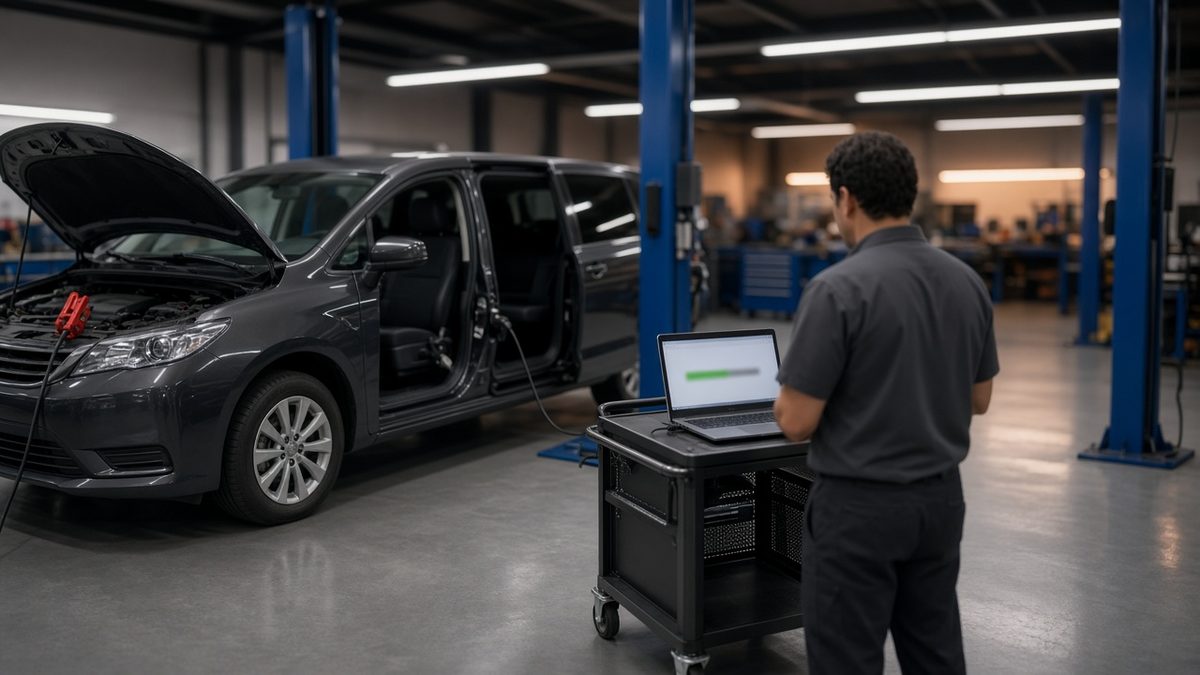
Most of this is software. Two big campaigns, Sienna and NX, are reflashes. On paper, that's easy work. In the bay, every tech knows a reflash isn't always a quick job. You hook up a battery maintainer, wait on the download, and hope the module takes the update on the first try. When it doesn't, you start over.
On straight flat rate, warranty pays whatever labor time the manufacturer assigns to the op. If the reflash goes clean, fine. If it hangs, fails, or needs a second attempt, the clock keeps running and the flag time doesn't move. Multiply that by a lane full of minivans in December, and recall season can turn into a lot of hours at the shop that never show up on the check.
The part swaps, like the Lincoln park module and the Ford tailgate cable, bring their own risks: parts that aren't in yet, cars that come in early because a worried owner saw the news, and checks that may not come with a labor op at all.
On hourly or hybrid pay, a slow reflash is the shop's problem to schedule around, not a tech's personal loss. That's how it should be. The tech doesn't write the software or set the warranty time.
Know your recall rate before the rush
Before letters go out in December, find out what warranty work actually pays you per clock hour. Track a week of recall ROs, clock time against flag time, and run it through the FlatRate.Live calculator. Then use How to Check Your Flat-Rate Paycheck to make sure every warranty op you turned shows up on your stub.
A recall is a safety fix for the customer. It shouldn't double as a pay cut for the tech who does it.
Sources verified Nov 2, 2026: USA Today (Oct 26 and Oct 27, 2026), Kelley Blue Book (Nov 2, 2026), Trucks, Parts, Service (Nov 2, 2026), and WBIW (Nov 2, 2026).